
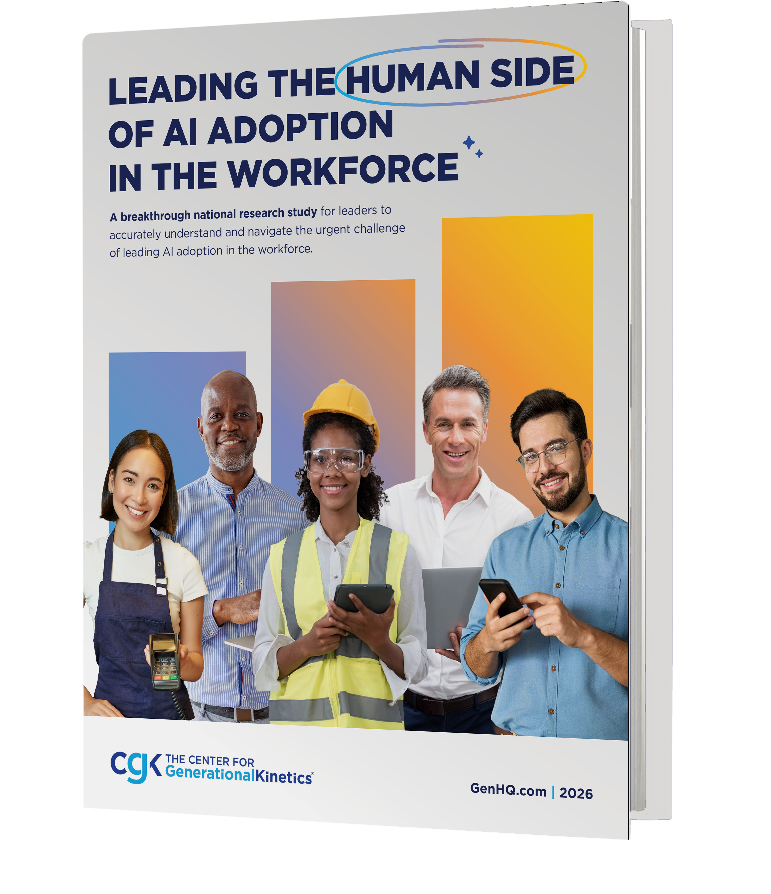


leading the Human side of AI Adoption in the workforce

A breakthrough national study of AI adoption, mindset, behaviors, and strategies 

Leading the human side of AI adoption in the workforce Study: A Breakthrough National Study of AI Adoption mindset, behaviors, and Strategies

LEADING THE HUMAN SIDE OF AI ADOPTION IN THE WORKFORCE

BreakthRough National Study oF AI Adoption Mindset, behaviors, and strategies that Leaders need to know

Leading the Human Side of AI Adoption in the Workforce is a national study from The Center for Generational Kinetics (CGK) of 1,000 employed Americans who used AI as part of their job in the previous 12 months. Fielded March 23 to April 14, 2026, the study uncovers the behaviors and mindsets that determine whether AI adoption actually produces results, and it includes the missing perspective on AI from executives, managers, and employees.

The findings provide the missing perspective and accurate answers leaders need to increase AI adoption, usage, and enthusiasm across their organizations.

Here’s just a glimpse of the many discoveries in the national study:

  • 78% of U.S. workers using AI on the job say that if AI increases their productivity, they should be paid more
  • Almost half of U.S. workers using AI on the job (46%) wish AI had never happened
  • 35% of the U.S. workforce who have used AI at work do not trust their organization’s leaders when it comes to AI plans
  • 80% of executives are enthusiastic about AI at work compared with 68% of managers and just 46% of employees
  • 59% of the U.S. workforce that has used AI at work say AI will become the most important job skill within one year
  • And numerous other must-know questions

download your free study now:

Leading the Human side of Ai Adoption in the workforce Report:

Enter your info below to receive the complete 37-page research study findings report

Our Insights are Trusted by Companies Around the World

below are a few of the many findings from the study:

The State of Gen Z® 2021-2022 Report: Gen Z as Employees and Trendsetters

Enter your info below to receive the complete 25-page research study findings report.

60% of younger Gen Z

(ages 18-22) wish AI had never happened

67% of U.S. workers

think AI will create significant unemployment around the world.

71% of U.S. Workforce

who have used AI in the last year think AI will be the biggest technology change in their lifetime.

66% of U.S. Workforce

agreed with the statement, "Eliminating a 5-minute work task you hate by using AI would increase your usage of AI at work."

Leading the human Side of AI Adoption in the workforce: Insights Overview

A Breakthrough National Study for leaders to accurately understand and navigate the urgent challenge of leading AI Adoption in the Workforce.

The new Leading the Human Side of AI Adoption in the Workforce national study makes clear that the biggest barriers to AI results are not necessarily the tools themselves. Trust, communication, confidence, and leadership all matter. While 57% of workers who have used AI on the job are enthusiastic (very/somewhat) about using it, 46% also say they wish AI had never happened. That tension reveals just how complex AI adoption has become.

The perspective gets even more interesting across job levels. Executives are far more enthusiastic about AI than employees, yet more than half of executives also report losing sleep because they were worried about how AI might affect them. While it may be easy to assume hesitation sits mainly with frontline employees, our study shows uncertainty exists throughout the organization, including among the leaders responsible for driving adoption.

At the same time, trust gaps are showing. More than one-third of U.S. workers who have used AI at work say they do not trust their organization’s leaders when it comes to AI plans. Employees want clarity about where AI will be used, what it means for their role, and how it can make their work better, not simply more messaging about the technology itself.

The stakes are high for organizations—but so is the opportunity. Employees are already showing leaders what will increase trust, confidence, and AI usage. Organizations that act on these insights won’t just accelerate adoption. They will be better positioned to turn AI investment into stronger performance, productivity, and long-term workforce value.

KEY QUESTIONS THIS REPORT ANSWERS:

  • Why is AI adoption not living up to its promise in many organizations?
  • What do employees fear most about AI at work? 
  • Are any employees enthusiastic about AI at work?
  • Who is most stressed about AI usage at work?
  • How do you build employee trust in AI usage at work?
  • Plus, numerous other essential questions

AI can change what work is capable of, but people determine whether that change actually happens. Our research shows leaders have to solve the human side of AI if they want to unlock the business side.”

—Denise Villa, PhD, CEO, The Center for Generational Kinetics; Co-Author of Zconomy

If the above discoveries and strategic questions resonate with your organization, you’re not alone—leaders everywhere are grappling with them. But the answers aren’t one-size-fits-all. Many leaders want to dig deeper into how the findings apply to their own teams, industries, and cultures. That’s why The Center for Generational Kinetics (CGK) partners with organizations to go beyond the data, applying these insights to your workforce through custom research studies, executive and leadership advisory sessions, and tailored presentations that spark action and alignment.

Ready to transform these national findings into strategies tailored for your organization? Contact us at Info@GenHQ.com or +1 (512) 259-6877 to explore how your leaders can engage with CGK—and turn insights into measurable results.


download your free study now:

Leading the Human side of Ai Adoption in the workforce Report:

Enter your info below to receive the complete 37-page research study findings report

CGK's Research Informs THE Global Conversation

Leading the Human side of AI Adoption STUDY METHODOLogy

The Center for Generational Kinetics (CGK) is the leading research, advisory, and keynote speaking firm focused on generations and must-know behavioral trends reshaping business and our world, such as AI.

CGK helps companies and leaders worldwide solve workforce challenges, grow with hidden consumer trends, and drive bottom-line growth through original research, strategy, and insights that deliver measurable results.

CGK released Leading the Human Side of AI Adoption in the Workforce to spark data-driven conversations about the intersection of the workforce, AI’s emergence, and the future of work. Learn more about CGK’s custom research and keynote speaking solutions at GenHQ.com.

The Leading the Human Side of AI Adoption in the Workforce research report was based on a first-of-its-kind national study by CGK of 1,000 employed Americans who had used AI tools as part of their job in the prior 12 months. The study was fielded from March 23 to April 14, 2026, and weighted to the 2020 U.S. Census for age, gender, region, and ethnicity. The study’s margin of error is ±3.1%. All comparisons described as significant in the research report are tested at the 95% confidence level.

Generational references used in the research report are based on the following age brackets and percentages: Gen Z (18–30) 33% · Millennials (31–46) 33% · Gen X (47–60) 27% · Baby Boomers (61–65) 7%. The gender composition was: Female 51% · Male 48% · Non-binary or prefer not to answer <1%. The regional distribution of study participants was: South 39% · West 23% · Midwest 21% · Northeast 17%.

“The national study revealed a complex, highly emotional range of views toward AI adoption in the workforce from those who have actually used AI in their job in the last year.

The intensity of the responses—from enthusiasm for AI to fear of its consequences—highlights the importance of leaders strategically guiding the AI conversation and implementation within their organization.

The study also reveals that the AI results gap is less a technology gap and more a gap in change management and technology adoption that can be bridged through specific actions, planning, training, and approaches that leaders need to know and use today.

We could not be more excited by the unexpected, actionable nature of the findings from the study and the ability to provide leaders with discoveries that they can act on today.”

—Jason Dorsey, President, The Center for Generational Kinetics; Co-Author of Zconomy

UNLOCKING AI Adoption at Work INSIGHTS AND SOLUTIONS FOR LEADERS ACROSS GENERATIONS

The Center for Generational Kinetics has led the field in generational and behavioral research for more than a decade, leading over 200 original, statistically accurate studies across four continents. Our work spans industries from global finance and healthcare to technology, retail, hospitality, manufacturing, and beyond, always with one goal: helping leaders turn data into measurable results.

The new Leading the Human Side of AI Adoption in the Workforce national study delivers findings every organization needs to know right now. From the surprising gap in AI enthusiasm between executives and employees to the fears slowing adoption, the trust challenges leaders must overcome, and the specific actions that can increase AI usage, this research reveals what is really happening as AI transforms the workforce, and why technology alone will not determine who wins.

The opportunity is here to turn AI uncertainty into trust, experimentation into sustained adoption, and technology investment into measurable results. The leaders who understand the human side of AI will be better positioned not only to accelerate adoption, but to unlock the talent, productivity, and potential of their people as work rapidly changes.

Download the full Leading the Human Side of AI Adoption in the Workforce research report today. Then let’s explore how these findings can be applied directly to your organization: through a custom research study you exclusively own, strategic advisory sessions with our research and generational experts, or a keynote or interactive program that equips your leaders with practical, research-backed strategies to build trust, increase AI adoption, and turn AI’s promise into people-led results.

Contact us now at Info@GenHQ.com or +1 (512) 259-6877 to get started.

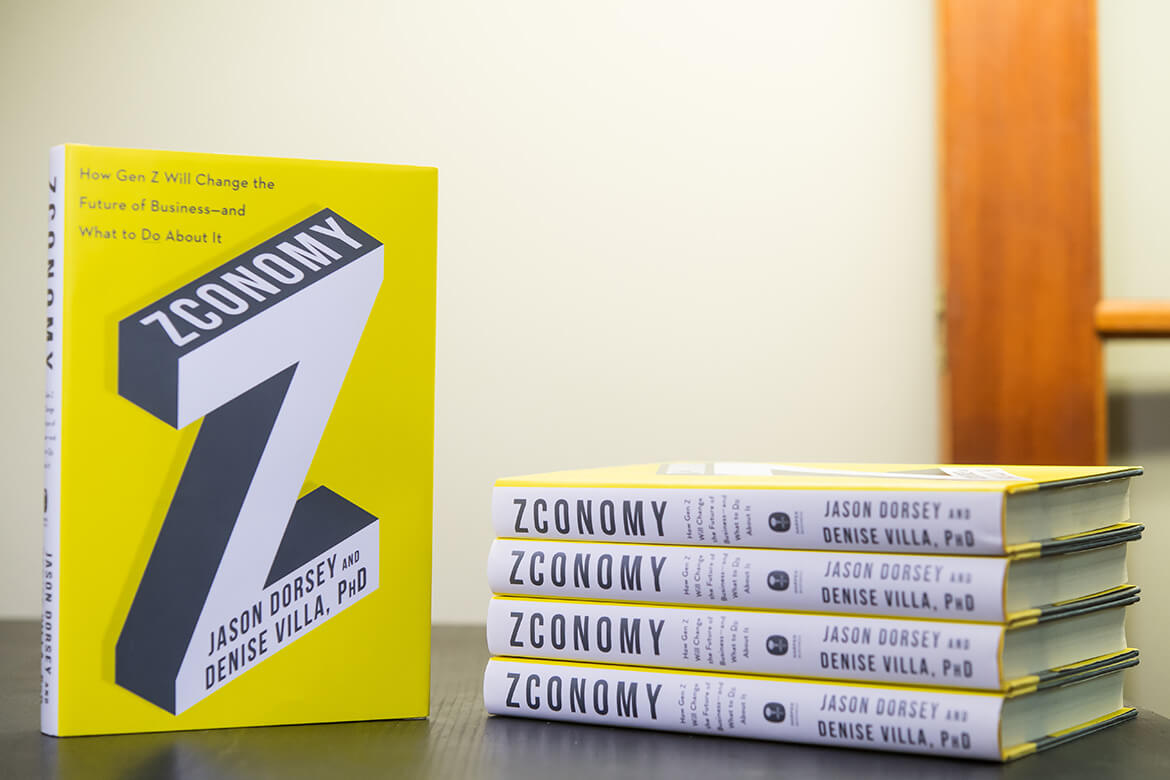
Want even more info on generation z? Check out zconomy

At CGK, we are passionate about unlocking the potential of Gen Z as they emerge as workforce, customer, and community trendsetters. Check out our bestselling book, Zconomy: How Gen Z Will Change the Future of Business, for all the insights and how-to strategies to unlock this exciting generation’s potential at this critical time.  

bestselling-zconomy-books-stacked

Questions Leaders Ask About This Research

Who was surveyed in the Leading the Human Side of AI Adoption in the Workforce study, and when?

The Center for Generational Kinetics surveyed 1,000 employed Americans who had used AI as part of their job in the prior 12 months. The study was fielded from March 23 to April 14, 2026, and weighted to the 2020 U.S. Census for age, gender, region, and ethnicity, with a margin of error of ±3.1% and significance tested at the 95% confidence level. Participants spanned four generations: Gen Z (18–30) 33%, Millennials (31–46) 33%, Gen X (47–60) 27%, and Baby Boomers (61–65) 7%.

How big is the gap between executive and employee enthusiasm for AI at work?

It is 34 percentage points. In CGK's 2026 national study, 80% of executives said they were enthusiastic about using AI at work, compared with 68% of managers and just 46% of employees, against a workforce-wide figure of 57%. A leader reading the room from the top of an organization is reading a genuinely different room, which is why AI plans that feel obvious in the C-suite often stall on the way down.

Do workers think they should be paid more if AI increases their productivity?

Yes, and by a wide margin. 78% of U.S. workers who use AI on the job say that if AI increases their productivity, they should be paid more. This is one of the clearest expectations in the study, and it rarely appears in AI rollout planning. Leaders introducing AI as a productivity tool should expect the question of who benefits from that productivity to follow it.

Does the U.S. workforce think AI will cause unemployment?

A majority does. 67% of U.S. workers think AI will create significant unemployment around the world, and 62% think AI is being used as an excuse to let go of employees an organization might otherwise struggle to fire. Among the youngest workers the feeling runs stronger still: 60% of younger Gen Z wish AI had never happened, significantly higher than any other generation.

What do leaders most often get wrong when driving AI adoption?

They lead with themselves. CGK tested ten actions organizations use to build trust in AI, and the one that finished last of all ten was showing how executives personally use and learn AI, at 20%. The most effective action was saying where AI will not be used, at 37%. Executives also carry more private stress than the frontline: 52% of executives report losing sleep over AI, compared with 31% of managers and 26% of employees.

How can an organization apply these findings to its own workforce?

CGK partners with organizations to take national findings further through custom research studies the organization exclusively owns, executive and leadership advisory sessions, and tailored keynotes and interactive programs. The Center for Generational Kinetics has led more than 200 original studies across four continents. To discuss applying this research to your workforce, contact CGK at info@GenHQ.com or +1 (512) 259-6877.