
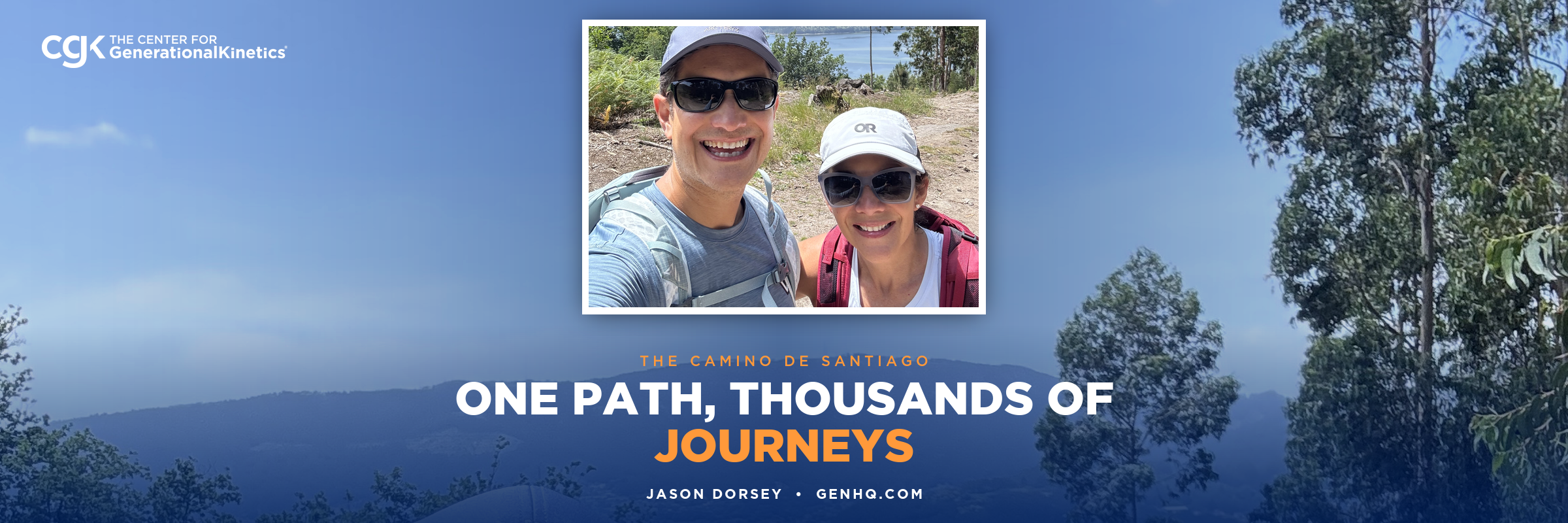
There are few experiences in life where people from every generation willingly choose the same challenge, walk the same path, and share the same destination.
The Camino de Santiago is one of them.
For centuries, generations have traveled the Camino for reasons as varied as the individuals making the journey. Some come seeking spiritual growth. Others want adventure, reflection, connection, or simply a break from the relentless pace of daily life. What struck Jason and me most during our time on the Camino wasn’t just the beauty of the trail—it was the extraordinary diversity of people walking it.
Every day felt like a living case study in generations.
We met a college professor leading students across Spain, hoping to give them a transformative experience beyond the classroom. We saw parents carrying babies on their backs as they navigated the same hills and valleys as seasoned hikers. We met retirees checking off a lifelong dream. Some travelers completed more than 30 days on the trail. Others joined for just a weekend. Some walked every mile. Others rode bicycles. There was no single “right” way to experience the Camino.
And that’s exactly what made it so powerful.
Different Generations. Different Motivations.
One of the greatest misconceptions about generations is that they all want the same things, just at different ages.
They don’t.
Different generations often bring different expectations, priorities, and perspectives to the same experience. Yet on the Camino, those differences didn’t create division. Instead, they created opportunities for learning.
Younger participants often approached the journey as an adventure or a chance for self-discovery. Mid-career adults frequently saw it as an opportunity to reset, reflect, and gain perspective. Older travelers often shared wisdom gained from decades of life experience while continuing to challenge themselves physically and mentally.
Everyone was walking the same path.
But everyone was on a different journey.
The Power of Personal Choice
What makes the Camino unique is that it allows for an incredible amount of personalization.
Walk for two days or thirty.
Carry everything on your back or use luggage transport.
Travel alone or with family.
Ride a bike or walk every step.
Stay in simple hostels or boutique accommodations.
The Camino doesn’t demand that everyone participate the same way. Instead, it provides a common framework while allowing individuals to define success for themselves.
That lesson feels increasingly relevant today.
Across generations, people are placing greater value on personalized experiences. Whether it’s how we work, learn, travel, or build relationships, the expectation is increasingly about choice and flexibility rather than conformity.
One Trail. Thousands of Stories.
When people ask about the Camino, they often want to know what it’s like.
The truth is that there isn’t a single answer.
The Camino is thousands of different experiences happening simultaneously.
It’s a college student discovering independence.
A professor helping students see the world differently.
A parent introducing a child to adventure.
A retiree pursuing a dream.
A family creating memories together.
A traveler finding clarity one step at a time.
The trail is the same.
The journey is uniquely personal.
And perhaps that’s why the Camino continues to attract people from every generation, every background, and every stage of life—and has for hundreds of years.
It reminds us that while our paths may look different, we’re often searching for many of the same things: connection, growth, purpose, and experiences that stay with us long after the journey ends.